Winter conditions
Kevin the Star StrikerWinter conditions are more than a backdrop in the Wild Soccer Bunch’s story. They are a physical blockade that closes the soccer field, confines the children to their homes, cancels the freedom they have been counting on, and makes the team’s eventual victory feel like a thaw earned through persistence. The season first appears unbeatable, but its pressure also creates the habits, frustration, and solidarity that allow the Wild Soccer Bunch to reclaim the field.
Definition and Setting
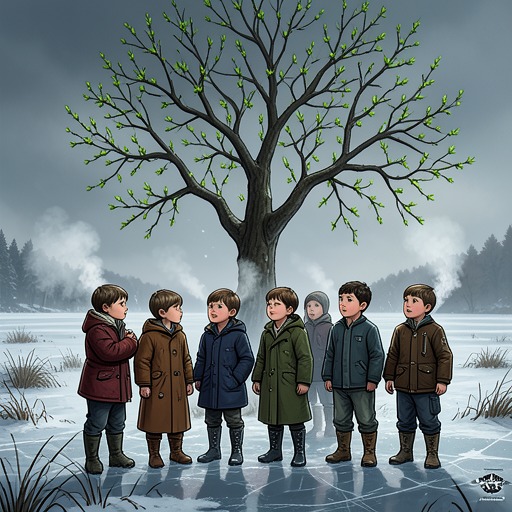
Winter arrives with unusual force in the north side of Chicago, where the ground is frozen solid, snow covers the neighborhood, and the wind blows with the severity associated with The Windy City. The season reaches far into April, leaving only five days before spring break while the children still face conditions more appropriate to an Ice Age than to the beginning of spring. At least seven inches of snow and ice cover the soccer field and the city, muffling not only ordinary activity but also the children’s dreams of playing.
The weather transforms the soccer field from the center of the children’s world into an inaccessible white expanse. Larry’s lemonade stand remains locked, its gutters shedding icicles into puddles, while the old bleachers overlook snow-laden trees and a field where soccer cannot begin. In previous years, the last day of school had opened the soccer season and Larry’s stand; this year, the same hoped-for period offers only the possibility of building a snowman. The contrast makes winter feel like an interruption of an established ritual rather than merely bad weather.
Confinement and Improvised Play
The prolonged cold confines Kevin and Tyler to their room on Wilson Street, where frost crystals cover the window and the sky remains gray. Their Christmas cleats make their feet itch, while Kevin’s scratched and scuffed soccer ball rests on his lap, turning the unused equipment into a reminder of the game they cannot reach. They imagine themselves hibernating like grizzlies, yet feel more like caged tigers at the Lincoln Park Zoo. The comparison captures the bodily restlessness produced by enforced inactivity.
The children respond by bringing soccer indoors. Kevin and Tyler throw the ball back and forth, calling the exercise goalie training even though Tyler is the number 10 midfield playmaker and Kevin is the center forward. They then begin kicking the ball against the wall, producing repeated “BAM!” sounds. Danny does the same at 44 Dearborn Street; Julian Fort Knox and Josh continue the rhythm across the street; and Alex Alexander turns a small space between a mirror and a china cabinet into a goal at One Woodlawn Avenue. The sound travels from Wilson Street to Dearborn Street and Woodlawn Avenue like a town-wide drum roll, allowing the children to remain connected even while the weather keeps them apart.
Roger, normally excluded from the indoor game, hears those sounds while trapped at home as his mother’s friends’ daughters put curlers in his red hair. The distant impacts give him strength and hope. Winter therefore produces an unexpected collective rhythm: the children cannot meet on the field, but their repeated kicks make separate houses feel like parts of one training ground.
The Weather’s Emotional Consequences
As spring break approaches, winter becomes a source of shared disappointment. Three days before the holiday, fist-shaped snowflakes strike the windows, while the children take the damp snow as a sign that a thaw may eventually come. Two days before the holiday, the sun finally appears through a crack in the stone-gray sky. Kevin and Tyler’s room has become an imagined Toyota Park, and their indoor game grows so intense that they shoot down model planes hanging from the ceiling without noticing.
The brief sunlight does not immediately end the larger crisis. After Alex Alexander’s globe-kicking incident leaves him grounded for twenty days, the next day is described as sad and colorless. At school, other children happily discuss their spring-break plans, but the Wild Soccer Bunch remain silent. The silence belongs not only to Alex but to all of them, because the weather has already made the promised two weeks of soccer impossible. When the final bell rings, they do not run toward freedom; they walk through slush while hearing only their footsteps and water dripping from icicles.
They gather at the soccer field despite having no plan, sitting on the old bleachers before the locked lemonade stand and the snow-covered trees. The gathering shows how deeply the field functions as their common home: even when winter makes play impossible, defeat draws them back to it. The children’s despair is expressed collectively, but it also becomes the starting point for their refusal to accept that the season has ended their team.
From Obstacle to Training Ground
Winter’s pressure helps turn frustration into preparation. The children initially try to drive winter away, but winter wins and refuses to leave. That defeat makes the Wild Soccer Bunch’s challenge to the Unbeatables more urgent: Mickey the Bulldozer declares that the soccer field belongs only to his group, while Kevin answers by giving them two weeks before the Wild Bunch returns to challenge them for permanent possession. The cold has prevented ordinary play, but it has also concentrated the children’s desire into a clear contest over the field.
When the match finally takes place, the weather does not disappear into ideal conditions. Rain begins while the score is seven to four, softening the ground into mud. The Unbeatables slide around like ducks on an ice rink, but the Wild Soccer Bunch have practiced on that kind of field for twelve days. Their apparent disadvantage has become a tactical advantage. The same hostile season that kept them off the field forced them to train for unstable, difficult ground.
The match’s rules also reveal how winter’s physical harshness is echoed by the social conflict around the field. Mickey the Bulldozer chooses a ten-goal format, and the Unbeatables insist that body contact is allowed. Roger adds the condition that the losing team must repair Larry’s stand. The game therefore joins weather, territory, violence, and responsibility: the field has been closed by winter, claimed by the Unbeatables, and made the stake of a contest whose result will determine who restores the damaged center of the children’s soccer life.
Thaw, Comeback, and Significance
The thaw first appears as a possibility in Kevin’s dream, where snow melts away from the globe and the first daffodils emerge. In the waking story, the transformation is slower and harder. The final match becomes the decisive movement from frozen isolation toward collective action. The Wild Soccer Bunch fall far behind, then exploit the muddy surface and their twelve days of preparation to score repeatedly: Kevin completes a hat-trick, Danny scores twice, Joey brings the score level at seven to seven, Tyler’s wind-carried shot makes it eight, and Diego becomes the Tornado again to produce the ninth goal.
The comeback is threatened by the same impatience that winter has generated. Kevin refuses to pass because he wants the tenth goal, so Larry removes him and puts Roger in his place. The Unbeatables draw level at nine to nine, and Kyle must make a last-second save to keep the winning goal out. Roger then scores the decisive tenth goal, turning the child once treated as an outsider into the hero carried across the field. The team’s victory is not a simple triumph over bad weather; it is the culmination of endurance, adaptation, passing, and trust forged under conditions that had made all of those qualities difficult.
After the win, the children carry Roger across the field while Kevin lies in front of the goal in disbelief. Larry extends his hand and congratulates them. Winter has not been defeated by a magical change in the weather alone. It has been answered by a team that learned to keep playing in bedrooms, to hear one another across separate houses, to train for mud, and to convert a season of confinement into a shared comeback. In that sense, winter conditions define the book’s early premise: an environment that first appears to destroy play can also create the discipline and solidarity through which play becomes meaningful again.